
The short answer
If your furnace is unsafe, keeps breaking down, or can't keep your home warm, replacement may be the right call. A single failed part, though, is often worth repairing. ArcticPoint HVAC Repair inspects the full system, explains your repair, gas furnace, and heat pump options, and handles installation in San Jose and nearby cities.
A furnace in San Jose doesn't work as hard as one in a colder state, but it still has to start reliably on damp winter mornings and run safely for years. The Santa Clara Valley's mild, wet winters mean many systems sit idle for months, then run every evening from late fall into early spring. When yours stops keeping up or raises safety concerns, ArcticPoint HVAC Repair can help you decide whether to repair it, replace it with a new furnace, or switch to a heat pump. Then we handle the installation from start to finish.
Signs You May Need a New Furnace
Furnaces rarely fail without warning. Most show a pattern of smaller problems first. If you notice several of these, have the system checked before it quits during a cold snap.
If a carbon monoxide alarm sounds, leave the house right away and call 911 or your gas utility. Don't run the furnace again until it has been inspected. We offer 24/7 emergency service for heating problems that can't wait.
- Rooms that stay cold or heat unevenly, even with the thermostat turned up
- The furnace turning on and off frequently, or a blower that runs without producing much warm air
- Repairs that keep coming back, especially to the same parts
- Yellow or flickering burner flames instead of a steady blue flame
- Soot, rust, or scorch marks around the cabinet or vent connections
- New rattling, banging, or squealing noises
- A carbon monoxide alarm going off, or headaches and drowsiness that ease when you leave the house
- Heating bills rising even though you haven't changed how you use the system
What We Check Before Recommending Anything
A good recommendation starts with the whole system, not just the unit in the garage or attic. On an evaluation visit, our technician looks at:
Sizing matters as much as the equipment itself. An oversized furnace turns on and off too often and wears out faster. An undersized one runs constantly and still leaves rooms cold. We size your system using a heating load calculation for your home, not by simply matching the old unit's rating.
- Heat exchanger condition, including visible cracks or corrosion
- Burners, ignition, flame sensor, and gas pressure
- Venting and flue connections, and how combustion air reaches the unit
- Blower motor and airflow through the system
- Ductwork for leaks, crushed runs, poor insulation, and undersized returns
- Thermostat location, wiring, and settings
- Electrical connections and safety controls
- The house itself: square footage, insulation, windows, and which rooms run cold
Repair, Replace, or Move to a Heat Pump
Not every struggling furnace needs to be replaced. If the heat exchanger is sound and the problem is a single failed part, such as an igniter, flame sensor, or inducer motor, a repair is often the sensible choice. We'll tell you when that's the case.
Replacement makes more sense when the heat exchanger is cracked, repairs are becoming frequent, parts are hard to find, or the furnace was never sized correctly for the house. In those situations, spending more on the old unit usually just delays the decision.
Bay Area homeowners also have a regulation to consider. Under the Bay Area Air District's Rule 9-4, natural gas furnaces manufactured from 2029 onward must meet a zero-NOx emission standard. In practice, that points homeowners toward heat pumps when they replace a furnace after that date. The rule does not require you to replace working equipment. It applies only when an existing furnace fails or is replaced, so a furnace with life left in it can keep running.
San Jose winters are mild, and summers can get hot, especially in the southern and inland parts of the valley. That makes a heat pump, which both heats and cools, a practical option for many homes. We can price a new gas furnace and a heat pump side by side so you can compare.
What Affects the Cost of a Furnace Installation
We don't quote prices without seeing your home. The same furnace can be a simple swap in one house and a bigger project in another. The main factors are:
Incentives can offset part of the cost of switching to electric heating. Check with BayREN and your local clean energy provider for current heat pump incentives. Amounts and availability change with each funding cycle, so we confirm the current offer before including it in a quote. The federal 25C tax credit for heat pumps covered only systems placed in service before December 31, 2025, and isn't available for new installations.
- Equipment type: a single-stage, two-stage, or modulating gas furnace, or a heat pump
- Efficiency rating and features such as variable-speed blowers
- Where the unit sits (garage, attic, closet, or crawlspace) and how easy it is to reach
- Venting changes, such as switching from a metal flue to PVC pipe for a high-efficiency furnace
- Ductwork repairs, sealing, or resizing
- Electrical work, especially if you're moving to a heat pump
- Permits and inspections required by your city
- Whether you're adding or replacing central air at the same time
How a Furnace Installation Visit Works
Here's what to expect from your first call to the finished installation:
If your furnace has already failed, tell us when you call. We'll talk through how to keep your household safe and comfortable while you decide on a replacement.
- Evaluation: A technician inspects your current system and home and asks how comfortable each room is.
- Options: You get a written proposal explaining each option, what's included, and why we recommend it.
- Scheduling and permits: We schedule the installation and handle the permit paperwork your city requires.
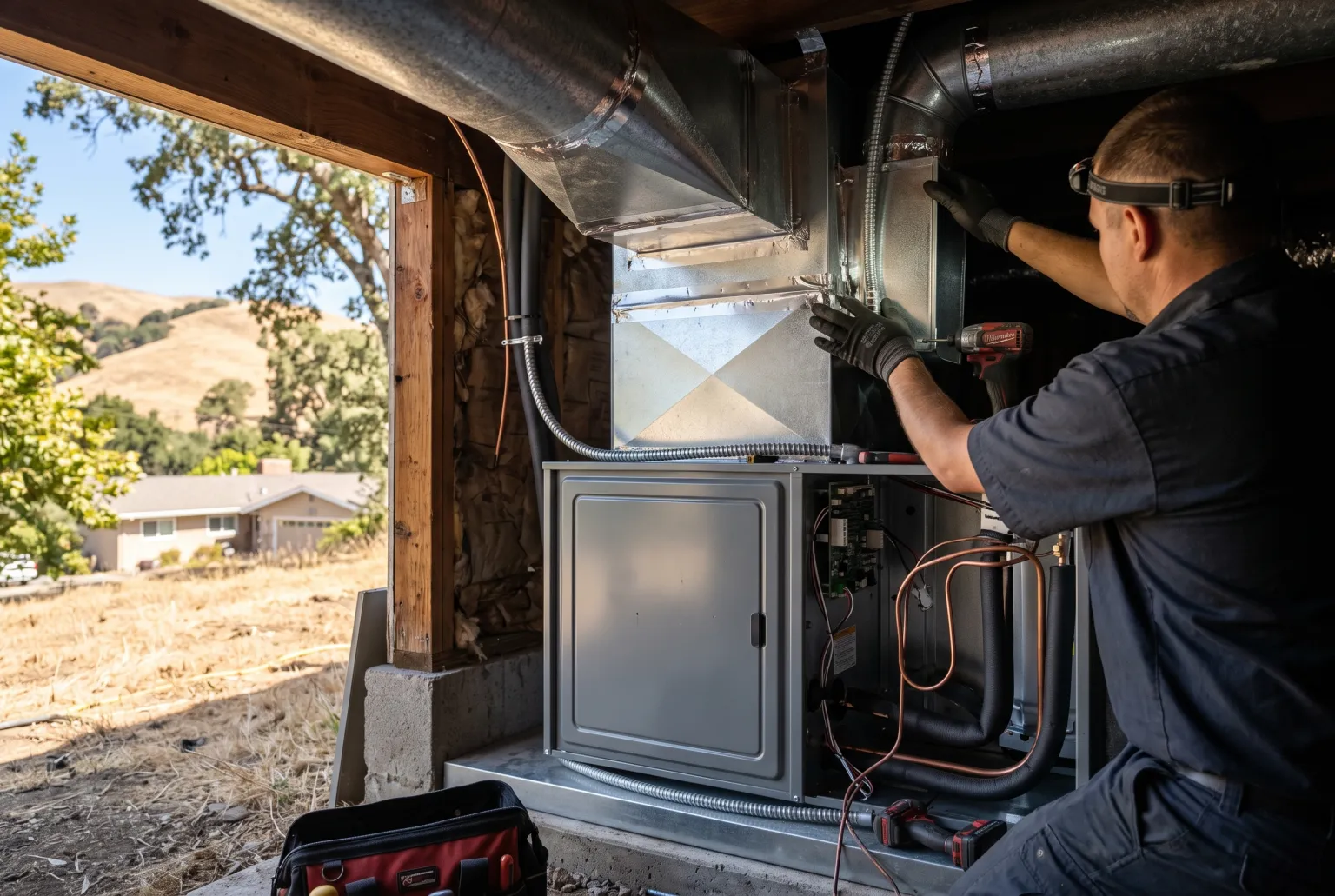
- Installation: The crew protects floors and work areas, removes the old unit, sets the new equipment, and connects the gas, venting, electrical, and ductwork.
- Testing: We check gas pressure, combustion, airflow, temperature rise, and safety controls, then set up your thermostat.
- Walkthrough: We show you how to change the filter and what to watch for, and we arrange the final city inspection.