
The short answer
If your furnace blows cool air, short cycles, makes new noises, or won't ignite, it likely needs repair. Most furnace problems are fixable. Bay Area air rules don't force you to replace a working furnace, so repair is often the sensible choice unless the heat exchanger or major components have failed.
Most San Jose homes don't run the furnace hard for months at a time. The Santa Clara Valley's mild, damp winters mean a furnace can sit idle through a long, dry summer and then have to work on the first cold night of the season. That's often when problems show up. ArcticPoint HVAC Repair fixes gas furnaces in San Jose and nearby cities, including Santa Clara, Sunnyvale, Campbell, Milpitas, and Cupertino. Below you'll find the warning signs, what our technicians check, how to think about repair versus replacement, and what to expect during a visit. If your furnace quits overnight, we offer 24/7 emergency service.
Signs Your Furnace Needs Repair
Furnaces usually give some warning before they stop working completely. Schedule service if you notice any of these:
A faint dusty smell the first time you turn on the heat in fall is normal. Dust settles on the burners and heat exchanger during the off-season and burns off. If the smell lasts, smells like rotten eggs, or your carbon monoxide alarm goes off, don't troubleshoot it yourself. Leave the house and contact your gas utility or emergency services from outside.
- No heat, or the blower runs but the air from the vents is cool
- The furnace starts and shuts off after a short time, over and over (short cycling)
- Some rooms are noticeably colder than others when they didn't used to be
- New noises, such as banging or booming at startup, squealing, scraping, or rattling
- A burning smell that lasts beyond the first few minutes of the season
- Yellow or flickering burner flames instead of a steady blue flame
- The igniter clicks repeatedly but the burners don't light
- The thermostat calls for heat but nothing happens
- Gas bills rising even though you use the heat the same way
- Soot around the furnace or vent, or extra condensation on nearby windows
What We Check During a Furnace Repair Visit
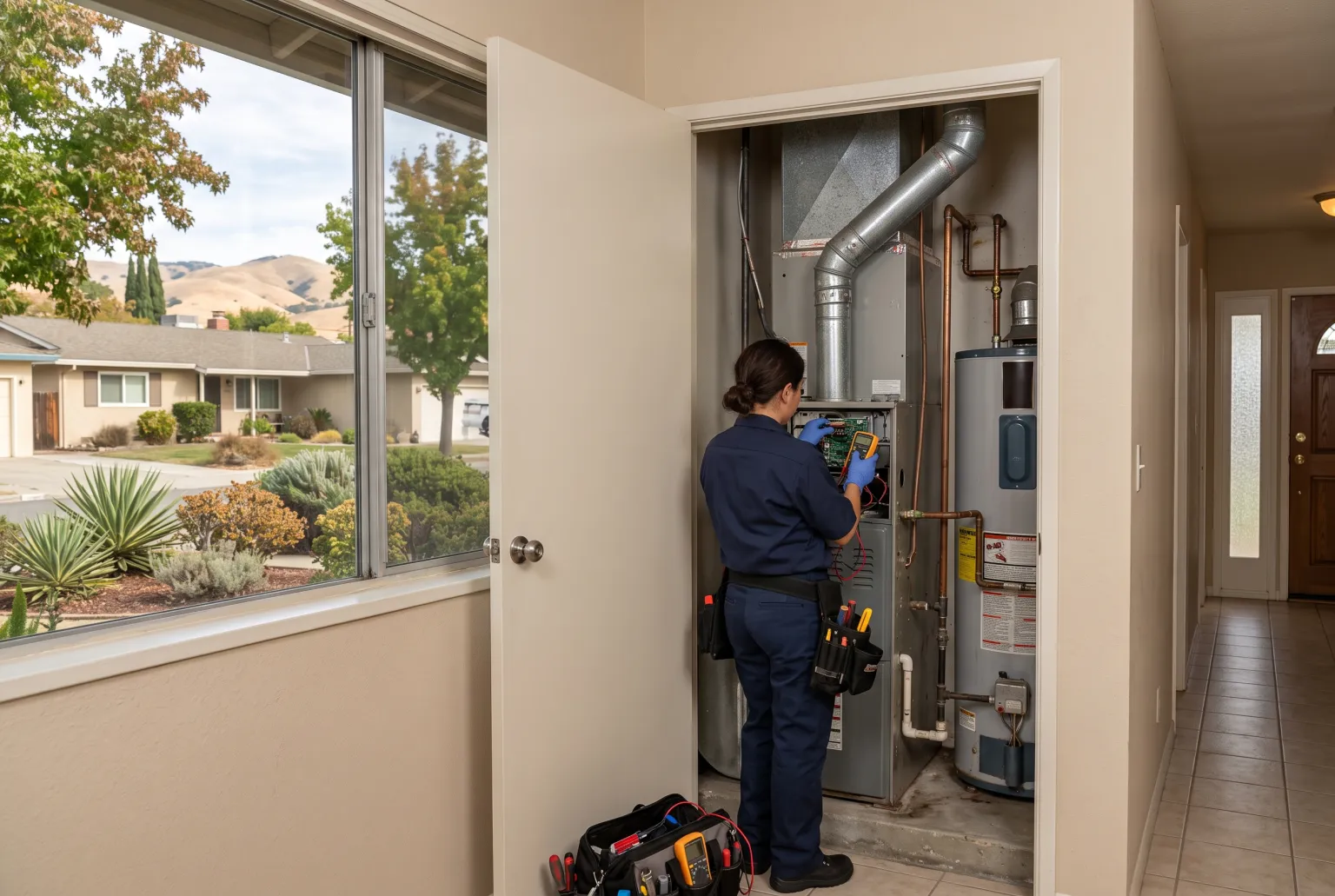
A repair visit should do more than swap the first part that looks worn. A failed part is sometimes a symptom of another problem. For example, a clogged filter can cause overheating that trips a limit switch. Our technicians work through the system to find the actual cause. Depending on the problem, that usually includes:
Once we find the problem, we explain what failed, why it failed, and what your options are before any work starts.
- Thermostat settings, wiring, and batteries
- Air filter condition and airflow on the return and supply sides
- Igniter or pilot assembly and flame sensor
- Burners and flame quality
- Gas pressure and gas valve operation
- Heat exchanger, inspected for cracks or corrosion
- Flue and venting, including draft and blockages
- Inducer motor, pressure switch, and limit switches
- Blower motor, capacitor, wheel, and belt on older units
- Control board error codes and electrical connections
- Condensate drain and trap on high-efficiency furnaces
- Carbon monoxide readings around the appliance
Repair or Replace: Weighing Your Options
Most furnace problems can be repaired. A failed igniter, dirty flame sensor, worn capacitor, or bad pressure switch is a routine fix, and replacing a whole furnace over one of those rarely makes sense. Replacement is worth discussing when the heat exchanger is cracked, when major components like the blower motor or control board fail on an older unit, when repairs have become frequent, or when the system has never heated the house evenly.
Bay Area air rules also matter for long-term planning. Under the Bay Area Air District's Rule 9-4, natural gas furnaces manufactured from 2029 on must meet a zero-NOx emission standard. In practice, that points homeowners toward heat pumps when a furnace is replaced after that date. The rule doesn't require you to replace a furnace that works. It applies only when an existing furnace fails or is replaced, so repairing a sound furnace is still a reasonable choice.
If you're considering a heat pump, check BayREN and your local clean energy provider for current electrification incentives. Amounts and availability change with each funding cycle, so we confirm the current offer before including it in a quote. The federal Energy Efficient Home Improvement Credit (25C) covered qualifying heat pumps placed in service before December 31, 2025. It isn't available for new installations after that date.
Heat pumps also provide cooling. That matters more in the hotter inland and southern parts of the valley than in areas near the Bay. We'll lay out both options plainly so you can decide.
What Affects the Cost of Furnace Repair
We can't price a repair until we know what's wrong. These are the main things that affect the cost:
Before we start, you'll get a clear explanation of the recommended work and what it will cost.
- Which part failed, and whether it's a universal or brand-specific part
- Part availability, especially for older or discontinued models
- Diagnostic time, since intermittent problems can take longer to pin down
- Where the furnace is installed: attic, crawlspace, garage, or closet
- Furnace type, such as single-stage, two-stage, or modulating, and standard versus high-efficiency
- Related issues, such as venting or ductwork problems, that also need attention
- Timing, including after-hours emergency calls
How a Furnace Repair Visit Works
Here's what to expect from start to finish:
Between visits, changing the filter on schedule and testing the thermostat before the first cold snap can prevent a lot of no-heat calls.
- Scheduling: Tell us what the furnace is doing, including any error codes or noises, and where it's installed. For no-heat situations, we offer 24/7 emergency service.
- Diagnosis: The technician asks a few questions, then inspects and tests the system as described above.
- Explanation: We walk you through what we found, show you the failed part when possible, and go over repair options and, if relevant, replacement options.
- Repair: With your approval, we make the repair. If a part has to be ordered, we tell you the expected timeline.
- Testing: We run the furnace through full heating cycles, check the safety controls and carbon monoxide levels, and confirm warm air is reaching your rooms.
- Wrap-up: We go over anything to watch for and simple upkeep you can do yourself.
Furnace Repair by city
- Furnace Repair in Los Gatos
- Furnace Repair in Campbell
- Furnace Repair in Morgan Hill
- Furnace Repair in Monte Sereno
- Furnace Repair in Saratoga
- Furnace Repair in Santa Clara
- Furnace Repair in Milpitas
- Furnace Repair in Cupertino
- Furnace Repair in Sunnyvale
- Furnace Repair in Scotts Valley
- Furnace Repair in Gilroy
- Furnace Repair in Los Altos